GearBerlin
What a Berlin gear house wants instead of a deposit
Year round
Ask a Berlin rental house for a lens set and you get back a form, not a price. Above a certain value the deposit model breaks down and is replaced by insurance certificates, business registration and a payment record. What each document has to say, and the point where an annual policy is cheaper than the alternative.
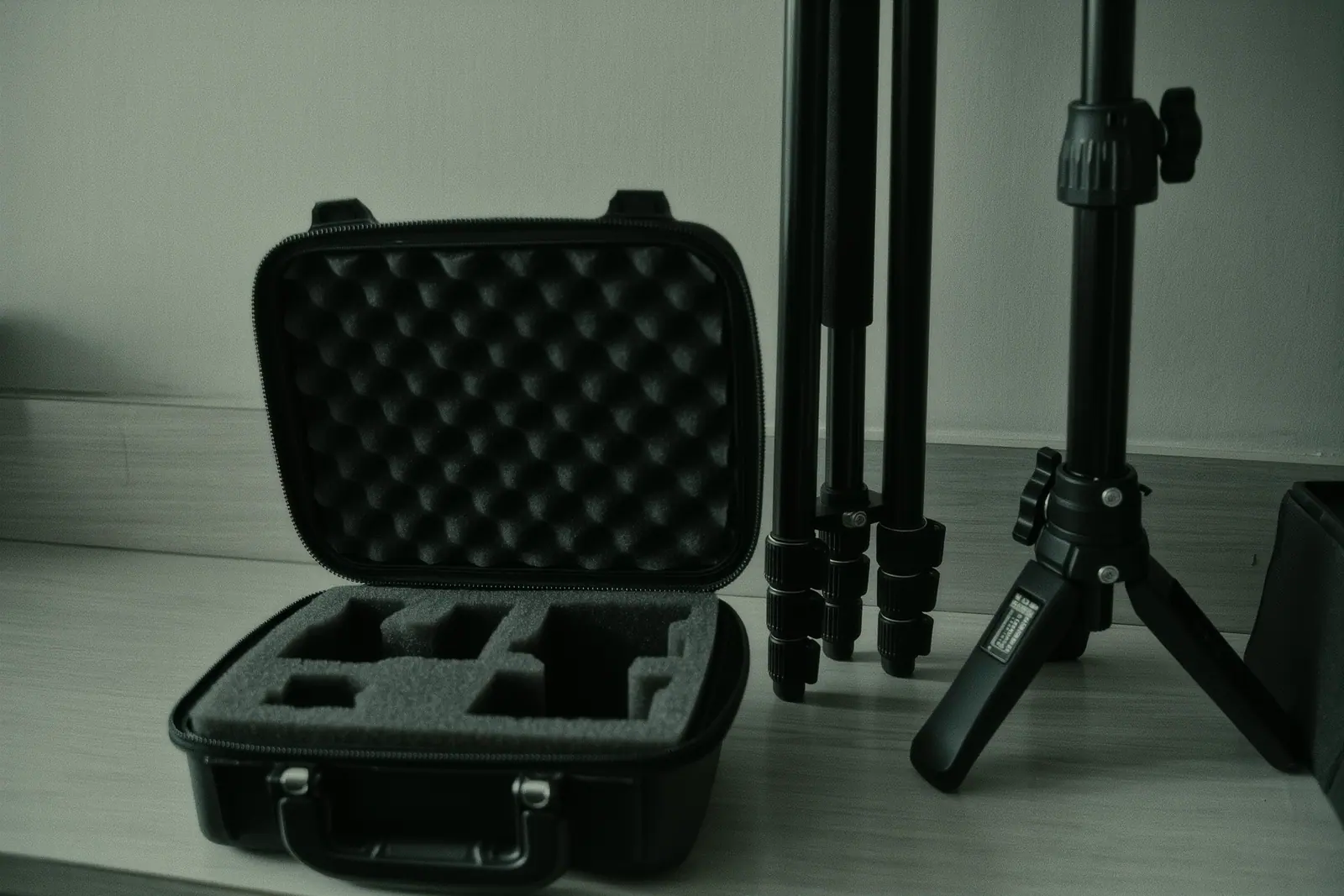
You sent a kit list on Monday: a body, four lenses, a monitor and two soft panels. On Tuesday you got back an email that does not mention the kit at all. It asks for a business registration, a certificate of insurance stating the sum insured and the territory, an identity document with a registration address, and whether you have hired from anyone else in the city.
Nobody is being obstructive. Above a certain value the deposit model simply stops working, and the trade replaced it with paperwork years ago.
Why the deposit breaks down
A deposit does two jobs: it makes you careful, and it pays for the damage. It does the first job well at any value and the second job only up to the amount somebody can actually put on a card.
A prime lens set, a body and a wireless video link add up to more than most people’s credit limit. Even if you could block that sum, the house ends up holding money and no mechanism — they still have to source a replacement, they still have a job booked on that kit next week, and the argument about whether the damage was yours happens in a car park.
An insurance certificate gives them a named insurer, an agreed sum, a claims route and a customer who is still speaking to them afterwards. That is why they prefer it, and why the paperwork is the price of entry.
What they actually ask for
| Document | What it proves | What goes wrong |
|---|---|---|
| Identity plus a registration address | You are traceable | An address that does not match the document |
| Business registration or tax number | You can be invoiced | Sole traders assuming they do not need one |
| Insurance certificate | There is a claims route | Sum insured too low, or hired-in kit excluded |
| Bank details or a card on file | Invoices get paid | A card that cannot take the excess |
| A reference from another house | Somebody has trusted you already | New arrivals in the city have none |
| First job paid in advance | Payment behaviour | Treated as an insult rather than a normal first step |
| Personal guarantee | A route past a thin company | Signed without reading what it commits you to |
Very few houses ask for all seven. Most ask for three or four and add the others if the booking value is high or the account is new.
Reading your own certificate before they do
Most people have never read the policy they are about to send. The rental house will, in about ninety seconds, and they look at five things.
- Sum insured. It has to cover replacement value, which is what the house would pay for a new item today, not what the item is worth used.
- Territory. Germany, Europe or worldwide. A shoot that runs out to the lakes in Brandenburg is still inside Germany; a weekend across a border is not, and the certificate has to say so.
- Hired-in equipment. A policy that covers your own kit does not automatically cover somebody else’s. This clause is the most common failure.
- Transport and unattended vehicles. Kit in a parked van overnight is excluded under most policies, or covered only in a locked garage. That exclusion is exactly the situation every real shoot creates.
- Excess. Yours, per claim. The rental house will invoice you for it, and on a small claim the excess can exceed the repair.
The part that is specifically Berlin
The trade here is smaller than the city is. The same freelancers move between the same houses, the counter staff know each other, and a bad return follows a name around for years. That works both ways.
On a first booking you will be quoted the full paperwork and probably asked to pay in advance. Do it without complaining, return the kit early, clean, with everything in the right foam slot, and the second conversation is entirely different. By the third you have an account, and by the fifth someone will hold a body for you on a phone call. There is no faster route than that, and no document that substitutes for it.
The reverse is also true: an argument at one counter about a scratched filter will be common knowledge in a fortnight.
Where a plain deposit still rules
Not every counter works this way, and it is worth knowing which world you are in before you turn up with a folder.
Tool hire, party and event equipment, and formalwear all still run on the classic model — identity, a card hold, a signature, done in ten minutes. The value per item is low, the items are repairable, and the trade is used to walk-in customers. That is why tool hire for a renovation can be arranged on the same day and a lens set cannot.
Studios sit in between: many will take a booking from anyone but ask for public liability cover before you rig anything to their ceiling, which is covered in photo studio hire and what a day rate includes.
When to buy the policy
Run the arithmetic once. If you hire professional kit more than a handful of times a year, an annual policy usually costs less than the sum of the short-period covers, and it removes a week of administration from every booking. If you hire twice a year, the single-production policy is the right instrument.
Either way, do it before the job exists. The single most common reason a Berlin booking collapses is not availability and not money — it is a certificate that was requested on a Wednesday and issued on the following Tuesday, by which point the kit you wanted has gone out to somebody whose paperwork was already on file.
What to check before you book
- Ask what a first-time customer has to supply before you send a kit list. The answer decides whether the booking is possible at all.
- Check that your insurance certificate names a sum insured at least equal to the replacement value of the kit, not its second-hand value.
- Confirm the territory on the policy covers everywhere the kit will physically be, including a drive out into Brandenburg.
- Read the transport and unattended-vehicle clauses. Kit left in a parked van overnight is excluded far more often than not.
- Ask whether the policy covers hired-in equipment specifically, not only equipment you own.
- Find out your own excess per claim, and whether the rental house will invoice you for it directly.
- Get the certificate issued before you need it. The underwriting takes days and the shoot is on Friday.
Questions people actually ask
- Why will a Berlin rental house not just take a deposit?
Because a working lens set is worth more than a car and a card hold of that size is unavailable to most customers. A deposit also gives the house a pile of money and no repair route, whereas an insurance certificate gives them a named insurer, a sum insured and a claims process. For low-value hires — tools, furniture, formalwear — the deposit model still works fine and is what you will meet.
- What insurance do I need to hire camera or lighting kit?
Some form of equipment or production cover that explicitly extends to hired-in equipment, with a sum insured that matches the replacement value of what you are taking. Short-period policies covering a single production exist alongside annual ones. The important clauses are territory, transport, unattended vehicles and the excess, and those are what the rental house will read first.
- Can I hire without a business registration?
Sometimes. Houses that work with students and first-time customers exist and will usually want identity, a registration address, a card hold and a personal guarantee instead. Expect a smaller first booking than you asked for, and expect to be offered the older body rather than the newest one. The second and third bookings are noticeably easier than the first.
- How long does it take to get set up as a new customer?
Allow a working week. The house needs your documents, may run a credit check, and has to open an account before it can invoice you. That is a background process nobody chases until the Thursday before a Friday collection, which is why the most common reason a booking falls over is administrative rather than technical.