On the roadBerlin
Driving into the low-emission zone with a rented vehicle
All year
Most of central Berlin sits inside a low-emission zone marked by a badge on the windscreen. Ordinary hire cars are fine. Older vans, specialist vehicles, one-way hires collected elsewhere and foreign-registered vehicles are where it goes wrong, and the driver carries the risk rather than the company.
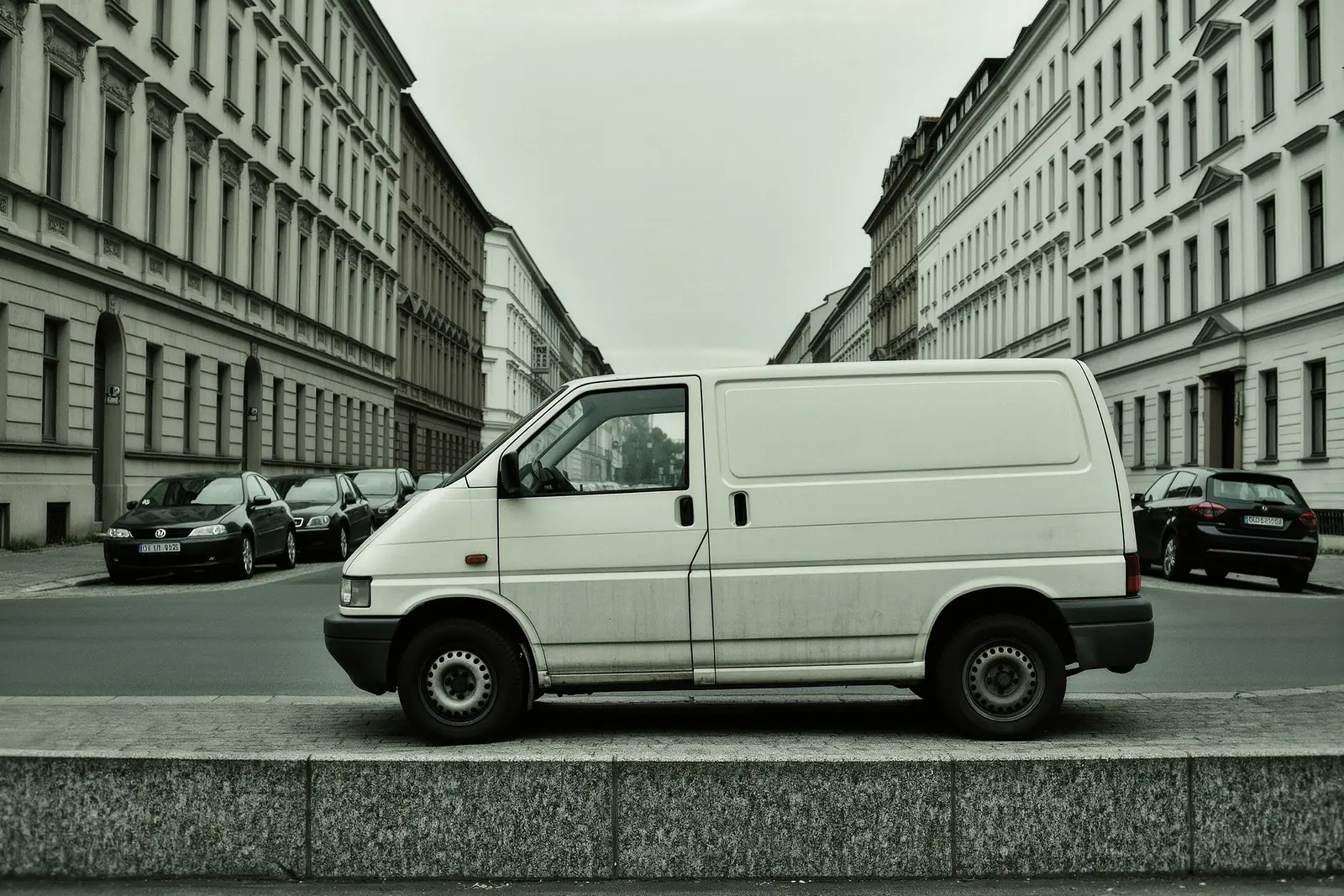
Nothing stops you. There is no barrier, no camera gantry, no toll, and no warning beyond a rectangular sign at the edge of the zone. You drive from Wedding into Mitte and the only thing that has changed is a legal obligation attached to a small round sticker on the windscreen.
That is why this catches people out with rented vehicles, and why it catches them out mostly with vans rather than cars.
The zone, and what it contains
The central part of the city, bounded approximately by the ring railway, is designated as a low-emission zone. That is a large area: Mitte, Kreuzberg, Friedrichshain, Prenzlauer Berg, Wedding, Moabit, inner Charlottenburg, Schöneberg and the northern edge of Neukölln all sit inside it. If your move, your shoot or your delivery is happening in the districts most people mean when they say Berlin, it is inside the zone.
Entry requires the vehicle to display a badge of the qualifying class. The badge scheme is set nationally; the zone boundary and its enforcement are the city’s. Both can change, so check the current position with the city or district authority rather than treating any description, including this one, as authoritative.
Two boundary details are worth knowing. The urban motorway that runs through the west and south of the city is handled separately from the surface streets, which means transit is generally possible without entering the zone proper. And the line follows the railway rather than a tidy administrative border, so at the edges — parts of Neukölln, Treptow, Lichtenberg, Wedding — the same district can be partly in and partly out. Look at the map.
Which rented vehicles actually have a problem
| Vehicle | Badge situation | What to do |
|---|---|---|
| Modern hire car, mainstream fleet | Fine, effectively always | Nothing |
| Recent panel van from a main depot | Almost always fine | Glance at the windscreen |
| Older van from a small independent yard | Sometimes not | Ask in writing before booking |
| Tail-lift truck, tipper, plant | Frequently the weak point | Ask, and ask about exemptions |
| Camper, older conversion | Varies a great deal | Confirm before the return leg |
| One-way hire collected in another city | Unknown until you see it | Confirm with the collecting depot |
| Foreign-registered vehicle | Needs a badge obtained in advance | Arrange before travel |
The pattern is consistent: the risk sits with age and with specialism. A three-year-old panel van from a large depot is not a question. A fifteen-year-old tail-lift truck hired for one Saturday from a small yard on the edge of the city absolutely is, and that is exactly the vehicle someone hires for a move into Prenzlauer Berg.

One-way hires and vehicles collected elsewhere
A vehicle picked up in Leipzig, Hamburg or Poznan and driven to Berlin has not been checked against the Berlin zone by anybody. The booking site does not know where you are going to drive, and the collecting depot does not necessarily know what Berlin requires.
Ask the collecting depot directly, and get the answer before you leave rather than at the city boundary. This applies just as much when the direction is reversed, since a vehicle dropped in Berlin still has to reach the drop-off point, which may well be inside the zone — the wider issue is covered in one-way van rental out of the city.
For a foreign-registered vehicle the badge is obtained in advance against the registration document. It is not something a police officer can sell you at the roadside and it is not something the rental company will fix retrospectively.
Exemptions exist, and they take time
Individual exemptions can be applied for from the responsible authority in defined circumstances — specialist vehicles, particular kinds of work, cases where no compliant alternative exists. This is a formal application with a decision at the end of it, not a form you complete on a Friday for a Saturday job.
If you know you will need one, start weeks ahead. If you find out you need one the day before, you do not have one, and the honest answer is to change the vehicle rather than to hope.
At handover, and afterwards
Two photographs. The windscreen with the badge visible, and the registration document. That is thirty seconds and it settles any later argument about what you were given.
Then be clear about who carries the risk. Driving without a valid badge is the driver’s offence, not the owner’s. The rental company will pass on any penalty notice with an administration charge on top, and “the van did not have one” is not a defence available to you at that point.
If the vehicle turns out not to qualify and you cannot change it, the practical workaround is geography rather than paperwork: depots, storage and industrial units are mostly outside the ring, the outer districts are outside it, and the motorway corridor lets you cross the city. What you cannot do is park a non-compliant hire van outside a flat in Friedrichshain for a day, which is the one thing everybody in this situation actually wants to do — and the parking side of that problem is set out in van rental and where you can actually park it.
What to check before you book
- Ask the rental company in writing whether the vehicle carries a valid badge for the Berlin zone before you book, especially for anything older or specialist.
- Photograph the windscreen badge at handover along with the registration document.
- Check the current zone boundary and the current badge requirement with the city or district authority, because both are set by the authorities and can change.
- For a one-way hire collected in another city, confirm the badge with the collecting depot rather than the booking site.
- If you are bringing a foreign-registered vehicle, arrange the badge before you travel. It is issued against the registration document and is not something you can produce at the roadside.
- If you need an exemption, start the application well ahead. Individual exemptions are decided by the responsible authority on their own timetable.
Questions people actually ask
- Where exactly is the low-emission zone?
It covers the central area of the city bounded roughly by the ring railway, which is a large area containing most of Mitte, Kreuzberg, Prenzlauer Berg, Friedrichshain, Wedding, Moabit, Schoeneberg and inner Charlottenburg. The precise line matters at the edges and the urban motorway is treated separately, so consult the official map published by the city rather than a rough description.
- Do hire cars have the right badge?
Ordinary modern cars from mainstream fleets essentially always do, and it is not something to worry about for a standard car hire. The vehicles that cause problems are older panel vans, tail-lift trucks, specialist plant, vintage vehicles and anything at the cheap end of a small independent fleet. Ask specifically rather than assuming.
- What happens if I drive in without one?
It is an offence and the penalty falls on the driver. There is no barrier and no toll booth, so people assume nothing is checked, but enforcement happens through roadside checks and through parking enforcement, and a vehicle without a badge parked inside the zone is conspicuous. The rental company will pass any charge to you along with an administration fee.
- I am hiring in another country and driving to Berlin. What do I need?
A badge obtained in advance, issued against the vehicle registration document. It can be arranged before travel and cannot be improvised at the roadside. Confirm with the rental company that they permit the vehicle to be taken into Germany, and check the current requirement with the responsible authority, because the rules are set nationally and applied city by city.
- Are there restrictions beyond the badge?
There have been additional measures on individual street sections at various times, aimed at particular engine types rather than at all traffic. These are decided locally and they change, so if you are driving something older it is worth checking the current position for your route rather than relying on what was true a year or two ago.