Two wheelsBerlin
What a cargo bike deposit and insurance actually cover
All year
The deposit is the smallest number in the conversation. What matters is the liability figure behind it, whether theft is covered at all, who owns the risk on a battery worth more than the rest of the bike, and the liability declaration you sign for a district lending scheme that costs nothing to borrow.
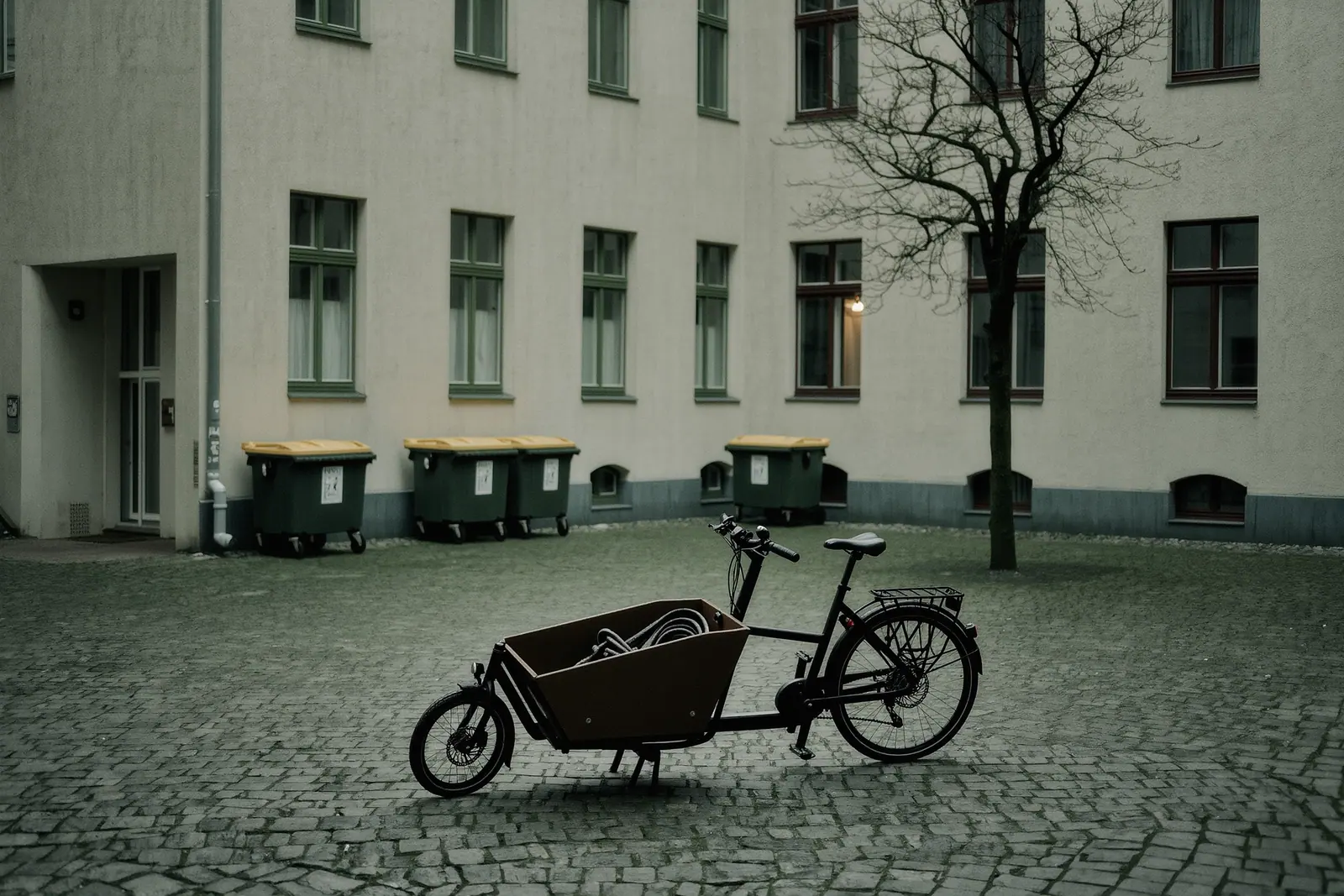
The money conversation at a cargo bike handover lasts about ninety seconds and almost all of it is about the wrong number. Someone tells you the deposit — three hundred euros, four hundred, held on a card — and everyone nods. The deposit is the least consequential figure on the page.
What matters is what you can be charged if the bike does not come back, or comes back broken, and that number is usually somewhere else in the contract.
Deposit, liability, excess: three different things
The deposit is a hold on a card, released on return. It exists so the shop has leverage, not so it can cover a loss. Typical range runs from the low hundreds for a plain long box to the high hundreds for a current electric one.
The liability limit is what you can actually be charged. On an electric cargo bike that can approach the replacement value of the machine, which is a serious sum. Ask for it explicitly. A shop that will not state it is telling you something.
The excess applies where the shop carries its own cover and passes a fixed first slice to you. This is the friendliest arrangement and not the most common one.
| Event | Usually covered | Usually yours |
|---|---|---|
| Scratches on the box | Yes, treated as wear | — |
| Cracked box panel | — | Yes, charged at repair cost |
| Punctures | Sometimes, at cost | Often |
| Damage you cause to a third party | — | Yours, via private liability cover |
| Theft with the supplied lock used | Partly, with excess | The excess |
| Theft with a different lock | — | All of it |
| Lost or damaged battery | Rarely | Yes, and it is expensive |
| Lost key | — | Yes, plus a lock replacement |
Theft is the live risk, not damage
Most cargo bike hires end without a scratch. The one that goes wrong tends to go wrong in the same way: the bike is left on the street for forty minutes and it is gone.
Berlin has a long-standing bicycle theft problem, and a cargo bike is a conspicuous, valuable and easily resold object. Three practical consequences:
- Use the lock they gave you, through the frame, to something fixed. A frame lock alone immobilises the wheel and does nothing to stop the bike being carried into a van. If cover depends on the supplied lock, using your own better lock can still void it — use both.
- Keep the key. Producing the key is how you demonstrate the bike was locked. Losing it after a theft is, in practice, the same as not having locked it.
- Report it the same day. Contracts typically require a police report within a short window, and the report number is what the shop needs. Do not wait until the morning.
Where the bike sleeps matters more than where it is parked at lunchtime. A courtyard behind a locked gate is the standard answer here, and it is worth asking the shop whether their cover distinguishes between a locked courtyard and a public street. Some do.
The battery is half the value
On an electric cargo bike the pack is the single most expensive removable component, and rental contracts increasingly treat it separately. Read that clause.
Three things typically sit on your side of the line: leaving the battery on the bike overnight, charging it with a charger that is not the supplied one, and storing it below freezing. All three are reasonable requirements and all three are easy to breach without noticing, particularly the first, because carrying a heavy pack up five flights is exactly what nobody wants to do at the end of a moving day.
Take it upstairs anyway. A stolen battery from a bike parked in a courtyard is a common claim, and it is one where the answer is usually that you should have removed it.
The free lending schemes, and what you are signing
Several districts here support neighbourhood cargo bike schemes: a bike parked at a shop or a community space, bookable through a shared calendar, free to borrow for a day. They are genuinely good, heavily booked, and the reason they are free is that the risk sits with you.
The typical arrangement is a signed declaration in which the borrower accepts liability for loss or damage, with no excess cap and no insurance layer. For a careful person moving boxes two streets away that is a fine trade. For an all-day move across three districts with a heavy load, a commercial rental with a stated excess is the cheaper form of the same day once you price the risk.
The handover that saves the argument
Do this every time, and it takes ninety seconds.
Photograph the frame number. Photograph the inside of the box, all four corners. Photograph both tyre sidewalls and the battery contacts. Count the straps out loud and write the number on the contract. Ride ten metres in the yard and pull both brakes hard.
Then read two clauses: what happens if you are late back, and what happens if it rains and the bike comes back filthy. Late returns on a Saturday are frequently charged as a full extra day because the next booking is real, and that is the charge people actually get stung by — far more often than any of the dramatic ones. If your day is tight, the loading plan in renting a cargo bike for a weekend move is the thing to fix first, and picking a shape you can load alone, as set out in which cargo bike shape suits which load, buys back more time than any clause in the contract.
What to check before you book
- Ask for the liability figure, not the deposit figure. The deposit is what they hold; the liability is what you can be charged.
- Establish whether theft is covered at all, and on what conditions. The supplied lock, the key and a police report within a stated window are the usual three.
- Ask specifically who carries the risk on the battery, and whether that is separate from the rest of the bike.
- Decline any request to leave a passport or identity card as security. A card authorisation exists precisely so you do not have to.
- Check whether your own private liability policy extends to a hired vehicle, and get that answer from your insurer before the hire rather than after an incident.
- Photograph the box interior, the frame number, both tyres and the battery contacts at handover, with the timestamp on.
- Read the return clause for cleaning and late charges. An hour late on a Saturday can be priced as a second day.
Questions people actually ask
- How big is a cargo bike deposit here?
Commonly a card authorisation somewhere in the low hundreds of euros for a plain unassisted bike, rising towards the high hundreds for a current electric model. It is a hold rather than a payment, and it is released when the bike comes back. What varies far more between shops is the liability limit behind it, which can be several times the deposit.
- Is theft covered?
Sometimes, often only partly, and almost never unconditionally. Where cover exists it usually requires the lock supplied by the shop to have been used, the key to be handed back as proof the bike was locked, and a police report filed quickly. Berlin has a high rate of bicycle theft, so treat this clause as the important one in the contract.
- What if I damage the box?
Scuffs and scratches on a plywood box are normal wear and most shops treat them as such. A cracked panel, a broken bench mount or a bent box floor is damage and will be charged, usually against the deposit first. Photographing the inside of the box at handover is the cheapest insurance available, because the interior is where arguments happen.
- Do I need my own insurance to ride one?
You are personally responsible for damage you cause to other people and their property, and in Germany that is normally handled by a private liability policy rather than by anything attached to the bike. Many households carry one; whether it extends to a hired cargo bike is a question only your insurer can answer. Ask before the hire, and ask specifically about hired vehicles.
- Are the free district lending bikes insured?
Usually far less than a commercial rental. Neighbourhood schemes typically ask you to sign a declaration accepting liability for loss or damage, which in practice makes you the insurer. The bikes are free to borrow and that is exactly why. If you would struggle to replace the bike, borrow a commercial one instead.